Применимость
| Модель | Двигатель | Год |
|---|---|---|
| 960 | — | 1995 |
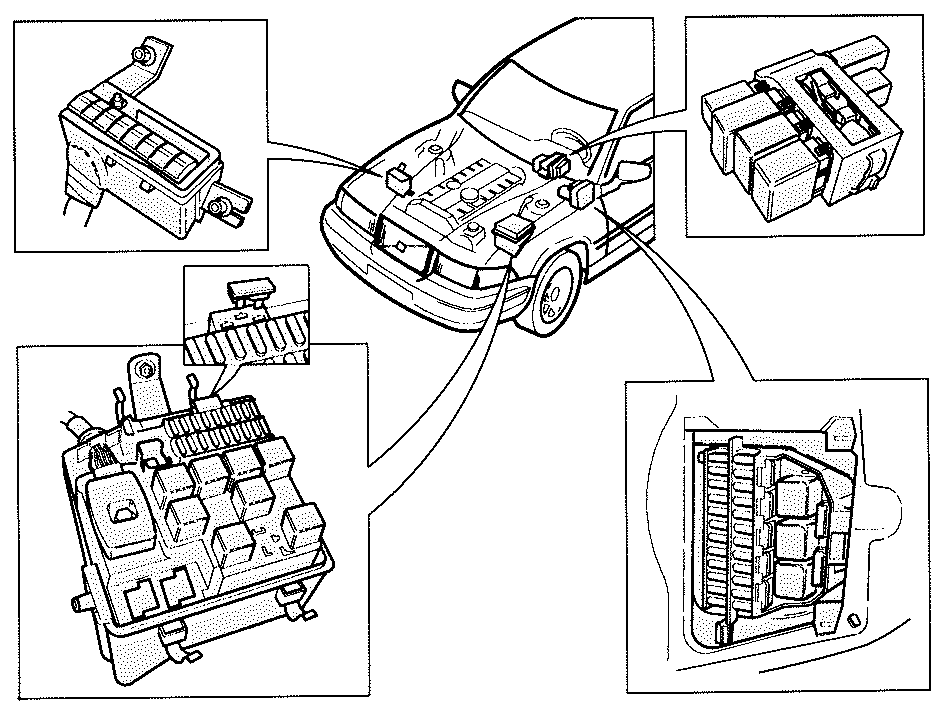
Integrated relay/fusebox engine compartmentFog light jumperCentral relay box, passenger compartmentService socketFusebox, passenger compartmentMain fuseboxThe previous system had reached a limit which made it difficult to enlarge the distribution system and functions. Therefore the Volvo 960 has a new electrical system which also provides the following benefits:
- Increased reliability due to fewer cable harnesses and connectors, amongst other factors.
- Relays and fuses more easily accessible.
- Better fuse protection of different components.
These changes mean that all wiring diagrams have been modified and that fault tracing of certain functions has to be done in a partially new way.On right-hand drive cars the passenger compartment fusebox is on the right-hand side of the dashboard, other electrical distribution modules have the same locations as on left-hand drive cars.
Electrical distribution modules
Main fusebox
Located just behind the battery the main fuse box contains eight 50 A main fuses. Fuse protection of supply cables directly from the battery gives the following advantages:
- Ensures that nearly everything in the car is fused.
- Better protection of cabling in the event of a battery or wiring short circuit by blowing a main fuse rather than the wiring melting.
- Allows a reduction in the cable cross-section of supply cables from the battery.
If a main fuse blows, a number of functions usually disappear and this means that there is a serious fault in the form of a short circuit that must be located and remedied.In the case of certain major loads in the engine compartment, the engine cooling fan (FC) for example, the supply cable runs directly from a main fuse to the component. This means that the "fusible link" cable for the engine cooling fan (FC) is discontinued.
Integrated relay/fusebox in the engine compartment:
The box in the engine compartment contains relays and fuses for the majority of functions in the engine compartment. Having relays and fuses close to their related components reduces the number of cables routed into the passenger compartment. The majority of those relays that were previously distributed at a number of locations in the engine compartment have now been brought together in the new central electrical unit. The aim was to use simple standard relays for as many functions as possible.All relays for the electrically controlled functions in the engine compartment and the front are however not located here as certain relays have sensitive electronics requiring a lower temperature environment, for example the main beam relay.There is room in the box for 18 fuses and 13 relays. There is also a foglight jumper, that allows simple control of the foglight function for the legal requirements of different markets, a service socket, to allow the starter motor to be operated and a 55-pin connector for the join between the engine cable harness and the engine compartment harness.There are two types of foglight jumper and they are physically coded so that they can only be connected in one way.The only separately fitted relay in the engine compartment is the engine cooling fan (FC) relay.
Relays
The relays, with their relevant position in the form of letter designations, are for the following components:A Air PumpC Main relay fuel injection systemF Air conditioning (A/C) compressorG Fog lampsL Fog lamp (only USA, has blue cover)M Parking lampsN HornJ Ignition coilsK Starter motorFour of the 13 relay positions (B, D, E and H) are spare. Most of the relays are simple make or break relays. The relay to the pulsed secondary air injection system (PAIR) pump and the fuel injection system has wider blade terminals because they conduct larger currents and should thus be able to dissipate heat better.
Fusebox in passenger compartment
The fusebox located in the passenger compartment has room for 24 fuses, five spare fuses, two automatic fuses and three relays. The attachment is modified. It is mounted on a bracket which is screwed to the cowl panel. This makes the rear of the fusebox more accessible, for fault finding for example. Two of the relays in the fuse box are overload relays activated via the ignition key, depending on its position and feed power to various consumers so that the cables with reduced cross sectional areas can be routed to the ignition switch. The third relay is for the fuel pump (FP).
Relays
Relays in fusebox in the passenger compartment.X-supply, fuel pump (FP) and 15- supply
Central relay box in passenger compartment
The relay box in the passenger compartment has relays for the majority of passenger compartment functions with certain exceptions, for example the station wagon intermittent rear wiper relay is located by the rear bulb failure sensor. The central relay box is modified to allow room with two relay bases since a number of these have been added: for cruise control, central locking and the alarm. The central relay box has two panel sides so as not to occupy too much room. The attachment to the tunnel is modified so that it can be raised with a single movement.
Relays
Relays common to the 850 have both number and letter designations.In the central relay box on the tunnel, where the relay bases are physically coded and marked with letters there are:Left side:A Time relay, rear window heater (also marked 208) B-E Cruise control module (also marked 101-102)D-G Central locking (205-206)C-F Alarm (210-211)Right side:H Seat belt reminder L Intermittent wiper relay (203)IHigh catalytic converter temperature warning (207) (Japan only). The four other relay positions (J, K, M and N) are spare.
A-, B- and C-fuses
The main fuse box is called the A-box, the relay/fuse box the B-box, the passenger compartment fusebox the C-box and the passenger compartment central relay box the D-box. The wiring diagram indicates the different fuses as A2, B5 etc. to designate for example; fuse 2 in the main fusebox and fuse 5 in the relay/fuse box in the engine compartment respectively.
Обсуждение и оценка
0Пока нет комментариев. Будьте первым.